Examination of early war photographs show that in Canada, the universal Maple Leaf cap badge and collar badges were worn by soldiers assigned to Military Police duty. As Battalions and Corps adopted their own badges, Military Police added their own insignia to indicate their status. Often, the only insignia identifying a Military Policeman was an MP brassard worn on the jacket cuff.


Overseas, soldiers appointed as Military Police initially wore either the Maple Leaf cap badge, the badge of their own battalion or corps or more rarely, British pattern Military Police cap badges. At this time, the British had two distinct Military Police units, the Military Mounted Police and the Military Foot Police. The Canadians followed suit in creating Foot and Mounted Police establishments. It appears that although Canadian Military Mounted Police (CMMP) and Canadian Military Foot Police (CMFP) brass shoulder titles were authorized, they were not produced. An example of an MFP shoulder title is included in an album of CEF badges designed and produced by Scully Ltd. of Montreal.
Around 1916 a Canadian pattern cap badge with matching collar insignia based on the British Military Police cap badge was adopted by some overseas MP units, but this does not appear to have been approved by higher authority, at least no written approval has as yet come to light. A very poor quality and incomplete sketch in the aforementioned Scully CEF badge album appears to show this Canadian pattern badge.

 |
 |
 Typical Canadian Maple Leaf Collar Badges |
 Canadian Pattern Cap Badge Unvoided Pattern |
 Canadian Pattern Cap Badge Voided Pattern |

There are two variations of the cap badge, a non-voided pattern with lugs and a voided pattern with a slider fastener. The non-voided pattern measures 46mm wide by 45mm high, while the voided pattern measures 46mm wide by 44mm high. Neither badge has been found hallmarked. Collar badges measure 31mm wide by 30mm high and are not hallmarked.


No. 1 MP Detachment located in London Ontario, adopted a Maple Leaf pattern cap badge along with matching shoulder and collar insignia. The cap badge measures 45mm wide by 45mm high. The collar badge measures 29mm wide by 29mm high. The brass shoulder title measures 39mm wide by 30mm high.
 Canadian Military Police Corps Cap Badge Other Rank's Pattern front |
 Canadian Military Police Corps Cap Badge Other Rank's Pattern reverse |
 Canadian Military Police Corps Cap Badge Officer's Pattern |
 Canadian Military Police Corps Cap Badge Officer's Pattern reverse |


Upon the formation of the CMPC in 1918, a new pattern of cap badge was approved. Trial badges were made at the arsenal in Quebec City and an initial run of badges was made by Scully Ltd in Montreal. Tiptaft in England made a further production run. The cap badge measured 36mm wide by 40mm high. Two variations of this badge are known : stamped gunmetal (brass) and a gilted cast bronze officer's pattern badge.
Rather than miniatures of the cap badge design, the authorized collar badge was the initials "C.M.P.C." The badge was 45mm wide by 13mm high and will be found back marked "BIRKS" on the reverse.
Standard brass or bronze Canada titles were worn on the epaulettes.
11 Special Service Companies were formed in Canada in 1917. Men who were overage or underage for overseas service, had recovered from injuries or wounds received overseas, or who were marginally unfit for duty overseas were recruited. They performed garrison duties and provided guards for vulnerable points as well as military police duties. Special Service Companies were reorganized on 4 April 1918 and absorbed by the Battalions of the newly formed Canadian Garrison Regiment.

Cap badges of No 2 Special Service Company. Two versions of the badge are known, one with the letters C.E.F on a ribbon under the Crown, and a version without the letters. 46mm wide by 49mm high.

Cap badge of No 3 Special Service Company. 44mm wide by 45mm high.

Collar badge of No 3 Special Service Company. 30mm wide by 30mm high. Made by Kinnear & D'esterre, Kingston Ontario.
The Canadian Garrison Regiment was authorized in April 1918 primarily from with a Battalion in each of the 13 Military Districts. Each Battalion had a Garrison Military Police detachment. Cap badges and collar badges worn by Garrison Military Police were likely the Maple Leaf pattern or that of the Canadian Garrison Regiment. A special cap badge was worn by members of No. 11 Garrison Battalion. Some Garrison Military Police were also appointed from NCOs of other regiments or corps. Garrison MPs so appointed wore the badges and insignia of their regiment. The Garrison Military Police brassard was worn by MPs on duty.


Canadian Garrison Regiment Collar Badges


During the First World War, Chinese labourers were contracted by the British government for service on the Western Front in Europe. After traveling by boat from China to Vancouver, they were transported by rail across Canada to Halifax. As Canada had blatantly racist laws regarding Oriental immigration and in order to prevent desertions among the Chinese during the trip, the Railway Service Guard was formed in Vancouver in 1915. The Guard provided policing and security during the trips and at staging camps along the route and at Petawawa Ontario. The Railway Service Guard was primarily formed from men either too young or old for service in the CEF, as well as discharged veterans. The Guard was disbanded about 1917 and most of the men were absorbed by the Special Service Companies. Although the Railway Service Guard was not a Military Police unit as such, they provided police type services and there is anecdotal evidence to suggest that some members wore MP type brassards. A cap badge and collar badge were produced for this unit but they appear to have not been officially approved by higher authority.
 Canadian Military Police Collar Badge |
 Wire Embroidered Officer's Canada Shoulder Title |
 |
 |
 |
 |
 Garrison Military Police Shoulder Title |
 Military Foot Police Shoulder Title Measures 44 mm wide by 19mm high |
 Military Mounted Police Shoulder Title Measures 50 mm wide by 19 mm high |
 Provost Marshall Staff No.10 Military District Cap Badge |
 Tunic and Greatcoat Buttons |
Military Police in Canada were tasked with identifying and arresting deserters and draft evaders and in the course of their duties were authorised to wear plain clothes. Civilian Police style badges were issued and Military Police carried certificates of authorisation, commonly known as "Warrant Cards".
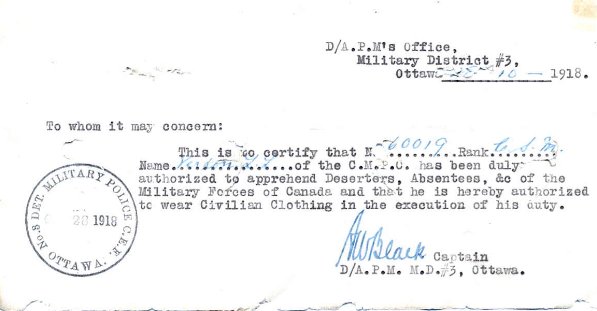
 No.3 Military District (Ottawa). Image courtesy of Cliff Grenfell |
 CMPC Ottawa. Image courtesy of Cliff Grenfell |
 No.4 Military District (Montreal) Identification Badge |
A brassard or armband has always been the primary symbol of authority for a Canadian Military Policeman on duty.
At the beginning of the war, a wide variety of brassards were used, evidently of local production. Photographs of MP in Canada show white brassards with blue or black sewn on letters, worn on the right or left cuff. Similar brassards with red borders were worn, as well as brassards with brass letters leather cuff band. Dark blue or black brassards with a metal MP badge were worn by Garrison Military Police in Montreal. The badge could be detached for wear with plainclothes. Overseas, Canadian MPs wore mostly British issued red and black brassards on the right arm above the elbow.
 Brass letters on a leather wristlet. Overall length: 37.2 cm |
 Brassard worn by MP Units in Canada. This brassard was likely originally secured with a buckle, it has been repaired and modified with snap fasteners. Overall length: 41.3 cm. |
 Garrison Military Police brassard worn by MP Units in Canada. Overall length: 38.0 cm |
 CEF Overseas pattern with Maple Leaf cap badge. Overall length: 48.5 cm. |
 Military Police brassard worn by MP Units in Canada. Overall length: 38.5 cm. |